Finding new ways to sing in the time of Covid-19, the Children’s Chorus of Maryland (CCM) came together for the second time in a “car choir” style rehearsal Saturday, October 31st, 2020 at the Maryland State Fairgrounds in Lutherville-Timonium.
While remaining in their cars, with the option to step out occasionally while socially-distancing, the singers each used an individual microphone and headset wired to a main console and speaker system designed by a sound engineer, in order to hear Artistic Director and Conductor Susan Bialek, the piano played by accompanist Patricia McKewen Amato, and one another's voices in beautiful synchronicity as they sang.
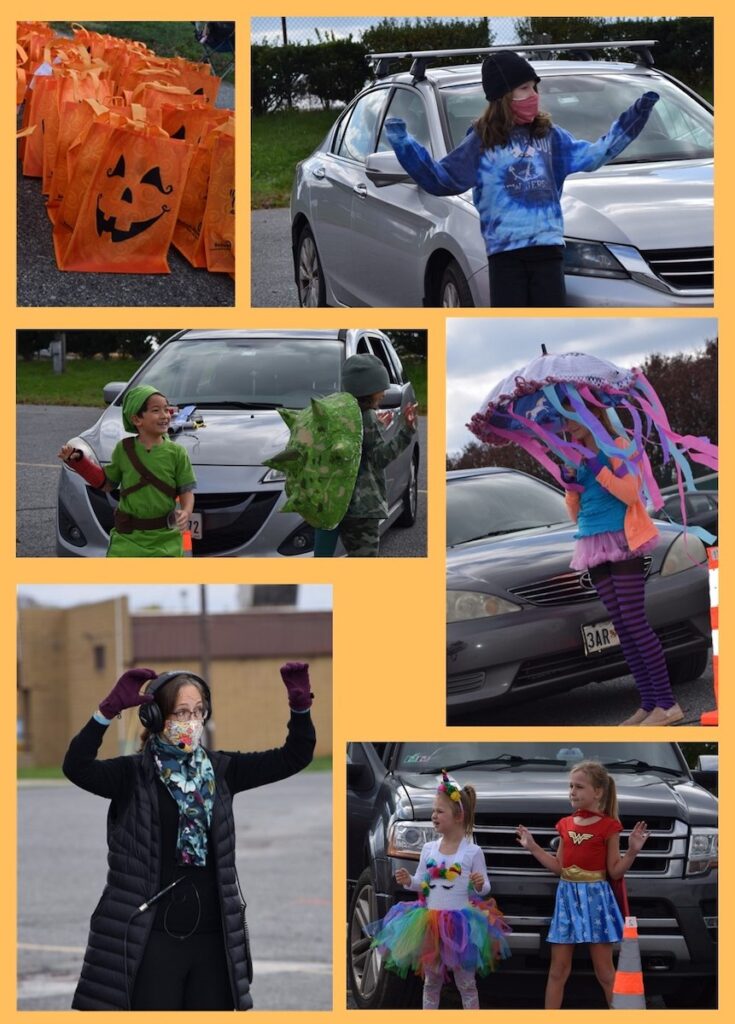
As this rehearsal took place on Halloween, all of our students were invited to wear their favorite costumes and safely get out of their cars to display their creations, accompanied by some spooky music. Children’s Chorus of Maryland was grateful to receive Halloween treats and bottled waters provided as a generous donation by Wegman’s of Hunt Valley.
Seven months passed without CCM students seeing one another in person or singing together and hearing one another in real time. With much research and planning on the part of the staff, the unwavering help of volunteers, and generous venues such as the State Fairgrounds and the Church of the Redeemer in Baltimore, CCM is planning several in-person car choir rehearsals this fall.
Children’s Chorus of Maryland is thrilled to announce this year’s Concert Choir is venturing on a mini-tour to Vassar College in Poughkeepsie, NY the weekend of October 25th to 27th, 2019. The Concert Choir will collaborate with Cappella Festiva Treble Choir and Cor Capriccio Children’s Choir. Children’s Chorus of Maryland’s current Artistic Director of five years, Susan Bialek, co-founded Cappella Festiva Treble Choir in 2006 and served as director from 2006 – 2014. She is also an alumna of Vassar College.
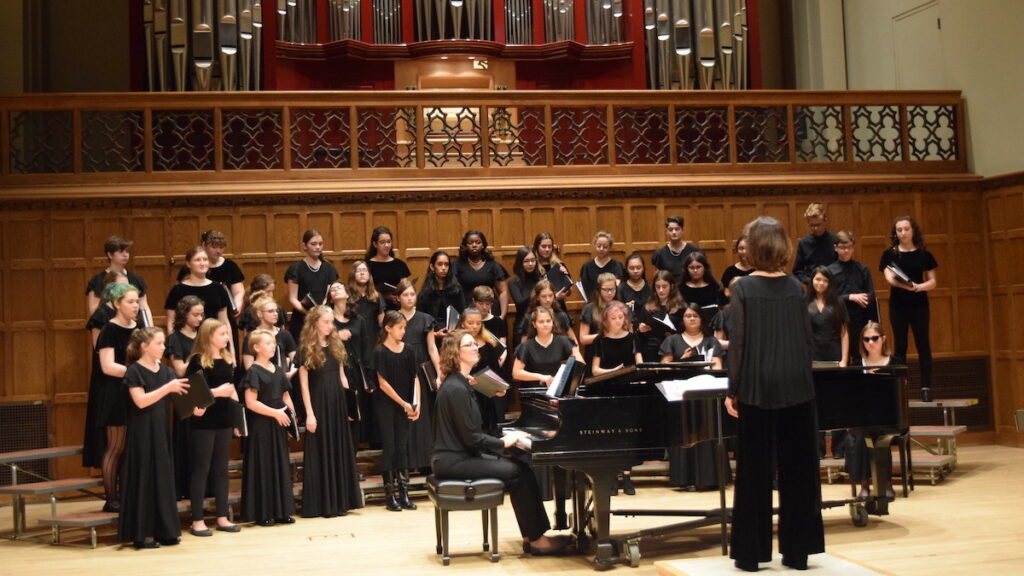
The tour and performance in Duchess County will be a wonderful opportunity to collaborate and explore for Children’s Chorus of Maryland Concert Choir members, who range in age from 12 to 18. The Cappella Festiva organization includes a 25-30 member children’s/youth choir, as well as a larger adult chamber choir, with whom Ms. Bialek sang for 10 years. The Concert Choir will work with Cappella Festiva under their new director of 5 years, Mr. Matthew Zydel, as well as the Vassar College Director of Choral Activities, Dr. Christine Howlett.
“Standing Together” is a collaborative performance featuring the Children's Chorus of Maryland Concert Choir, Susan Bialek, conductor, and Cappella Festiva Treble Choir and Cor Capriccio Children’s Choir, Matthew Zydel, conductor, and Elizabeth Clifton, conductors. “Standing Together” will be performed on Sunday, October 27t at 1:00 PM in the Skinner Hall of Music at Vassar College.
In addition to performing, the Children’s Chorus of Maryland Concert Choir will visit Hyde Park, New York, home of President Franklin Delano Roosevelt’s residence and the Presidential Library along the Hudson river, at a particularly beautiful time of year. They also plan to walk the Walkway Over the Hudson State Historic Park, the world's longest elevated pedestrian bridge, which spans 1.28 miles over the Hudson River. The mini-tour will surely be an inspirational weekend for both Children’s Chorus of Maryland and Cappella Festiva.
Images were taken during the mini-tour.
By Andrea Burgoyne
This article is part of the Awakening the Natural Musician in Your Child series. 1
We want so many things for our children—opportunity and purpose; education and success; fulfillment and happiness. We pour ourselves into giving them the best we can. Sometimes our days and theirs—can come to feel like a treadmill, running from activity to activity, enrichment to enrichment. How do we choose the things that will have the most benefit for them, both now and for a lifetime?
Most parents know the value of sports—especially team sports, which foster collaboration, determination, commitment, good sportsmanship, and excellence. But did you ever think about music that way? Music is a team sport too. A child who sings or plays music in a group learns a similar skill-set to an athlete—collaboration, self-discipline and commitment, mastery of the body, and pursuit of high standards. Moreover, music stimulates creativity, gives access to beauty, and awakens joy. This list reflects so many of the things we most hope for, for our children.
“If you cannot teach me to fly, teach me to sing.”
James Barrie
Music also has profound benefits for the brain. Collaborative music-making, such as singing in a choir or playing with a band, requires something extraordinary—the musician must listen and produce sound at the same time. There are few other endeavors that require such high-level processing of simultaneous input and output. Generally we take turns, listening then speaking, but in music we do both at once. Not only that, but singing engages both the verbal and the mathematical regions of the brain, while also triggering physical involvement— that urge to tap a foot or clap to the beat or hop up and dance. Even infants will wiggle and rock in time to music before they can stand or walk. Watch your child as he responds to music, and you will see how fully the mind, the body, and the spirit are enlivened and engaged.
There are so many other desirable attributes that can be strengthened by music—memory, attentiveness to detail, patience and focus—the list is long. But just as important are music’s emotional and psychological benefits.
“Music expresses that which cannot be put into words, and that which cannot remain silent.”
Victor Hugo
Ask any parent and they will tell you -- no one gets through the middle school years without some turmoil. But just as rocking and singing comforted your infant and lulled her to sleep, the child who has access to music—especially who has the opportunity to make music of their own—has a powerful tool to help them contend with life’s turbulence, as well as a path for constructive engagement with peers. Whether they use it for self-expression or relaxation, distraction or focus, simple pleasure or a way to process emotion, music can be both a source of happiness and a refuge in a storm. Said one young singer, "Every year I’ve spent [in chorus], I’ve gotten shivers from my arms to my toes and in that moment I know that I am completely and undeniably happy."
Both of my children sang in a chorus. The music was beautiful, and the memories are precious. But just as treasured are the life skills they were developing as they sang: To commit to giving their best even when it was hard, showing up even when something else tempted them; to appreciate other cultures and traditions, and value the gift of diversity; to be reliable and pull their weight. They discovered the power of music in times of sadness or despair—that they could sing even when their spirits were sagging—and that singing often lifted their heart. They learned to tolerate moments of failure, and to get up and try again and rejoice in their triumphs. And they learned that there was a spark inside of them that could do great things, and give joy to others. We all need the lessons that music can teach.
Relatively few of us are still playing field hockey or soccer in our 40’s. But a high percentage of those who engaged in group-music-making as children remain involved throughout their lives. Research conducted at George Washington University in the early 2000s demonstrated a relationship between singing in a chorus and the physical and mental health of a population of older adults. The seniors in the chorus showed improvements in health, fewer doctor visits, less depression, less need for medication and fewer falls, compared to the non-singing control group.
Increasingly, music is being used in therapies for older people, particularly in the treatment of Alzheimer’s, dementia and depression. Among the benefits cited are better memory recall, better non pharmacological pain management, and positive changes in emotional states.
There are studies that suggest connections between singing and social engagement, music and immune response, and even singing and disease mitigation. When we choose activities for our children, we’re probably not thinking much beyond those college applications. But music is a choice that can pay off all their lives.
The idea of music study can be daunting—it can involve a good bit of time, effort and cost. But long before you decide to invest in formal study, there are so many ways to infuse a young child’s life with music exploration. Earlier articles in this series have explored playful music making, but here are a few more suggestions: Everything in the environment has the potential to make a sound—shake it, tap it, drag it, roll it, scrunch it, blow into it, pop it. Make instruments out of found materials and recyclables in your home. Challenge your child to find the music in everyday things. (And check out the links on the next page for inspiration!)
A wonderful tradition in our family is “Family Music Night”. Get the gang together and make noise! If you have an instrument, play it. If you don’t have one, play whatever makes a sound—wooden blocks, a dried gourd (maracas!), a particularly resonant coffee can. If you have nothing to play, then sing, dance, make mouth noises! Even the littlest family member can participate, and while the music may be unrefined, the videos are priceless!
Nature walks are lovely times to listen as well as look. The quiet of the woodland is really a cacophony of insects, birds, trees creaking in the wind, branches snapping underfoot, leaves rustling, and creatures scurrying. Walk quietly with your child through nature while recording the woodland chorus on a cellphone or other recording device. She will be surprised at how un-silent the silence was! Can she identify those sounds? Imitate them? Sing along with them? Use them to make sound effects or to simulate a beat box? On another day, do the same on a walk through the city, and listen to the different natural music of that environment.
“I’ve always thought people would find a lot more pleasure in their routines if they burst into song at significant moments.”
John Barrowman
Make up silly songs in the car or during bath time. Teach your kids a “clean up song” and see if they can get the toys put away before it’s over. Incorporate family music-making into your holiday celebration —it doesn’t have to be good, just enthusiastic! Exploring sound and creativity leads to music. And music can lead you anywhere.
“If I were not a physicist, I would probably be a musician. I often think in music. I live my daydreams in music. … I get most joy in life out of music .”
Albert Einstein
Neither of my kids made music their career—but that was never the point. When they played a sport, or studied for a final, or entered a competition, or dug deep for their best efforts, or opened their hearts to someone very different from themselves—they were drawing on the things they had learned in that childhood chorus. Music does so much to refine and develop the mind, the heart, the will and the spirit. Whether a person becomes a brain surgeon or an auto mechanic, a cook or a veterinarian, a carpenter or a pilot—I believe that they will do it better, because music was part of their lives.
FEATURE IMAGE: The CCM graduating class of 2008 includes Andrea's son (far right).
ABOUT THE AUTHOR: Andrea Burgoyne is in her 22nd year of involvement with Children’s Chorus of Maryland (CCM), beginning as a parent, volunteer, and board member, and currently serving as Executive Director. She received her BA in music with a concentration in Vocal Performance from Towson University, and worked as a performer and teacher of voice, piano, early instruments and music theory for more than 30 years before joining the CCM Staff.
By Lauren McDougle
This article is part of the Awakening the Natural Musician in Your Child series. 1
As the academic year winds down, your child will have more free time during the summer months. Use that time for joyful, relaxed music making in your own community. There are many benefits to participating in local music programs. Often because the summer session is shorter in length, the cost is minimal. This means your child will have an opportunity to experience and experiment with a variety of artistic endeavors, before making a large commitment. Many parents know too well the struggle of completing an extracurricular activity that the child is no longer interested in, so look for a summer activity! Visit your local library or check the local newspapers for more information about what may be going on in your community.
Some of the most accessible music programs are community-based ensembles. Usually, these groups have no audition requirements and may only come with a small fee to join the association. When joining an instrumental ensemble, musicians will have to provide their own instrument. These groups are often comprised of other amateur musicians that also have a love and passion for music making and perform two to four concerts per year. A majority of suburban and metropolitan areas will have community choirs, bands, and orchestras. If you’re in a more rural area, then churches are wonderful resources for music making. Usually joining the church choir is free, and there will be weekly opportunities to perform, with several larger performances on or during religious holidays.
Community ensembles are wonderful for older children in middle and high school, but younger musicians will need more developmentally appropriate performance activities. Join a youth orchestra or a children’s choir. The conductors and teachers in these ensembles are specifically trained to meet the cognitive, social and emotional needs of a growing child, allowing them to thrive in their musical environment. Depending on the ensemble, these organizations will often charge a fee and meet throughout the school year. However, if committing to that is still too intimidating, look for a summer camp!
Many local music ensembles and musicians will offer summer sessions or summer camp. Sometimes these camps will have themes, or work towards creating some type of culminating performance experience. Depending on the type of camp attended, children can hone their skills in group work, or in solo study. Music camps often offer ensemble performance opportunities with some private lessons. Some of these camps are highly competitive, designed for a child who may consider a future career in music, while others are more experiential in nature. Local universities and colleges will often provide these camps, or can be helpful when looking for a good fit for your child. If you’re looking for something more like long term training after a great experience at camp, local music professors and graduate students usually have private studios and offer private lessons and music theory tutoring in the evenings and on weekends.
Music performance isn’t limited to choral, band, and string experience ensembles. Music abounds in other areas of the arts, and there are so many opportunities available to your child. Community musical theater is yet another budget-friendly activity that your child can pursue. There are opportunities to help back stage, act on stage, and even play in the pit band. Often exposure to musical theater also means dance, and most communities have access to dance studio classes. Ballet, jazz, tap, hip-hop, and contemporary dance classes are abundant with the rising popularity of T.V. hits like So You Think You Can Dance, and the publicized success of Misty Copland. Dance allows people to express music through their body, and some of the best musicians in the world have studied dance or Dalcroze to increase their expressivity, creativity, and even relaxation and posture. Dance is collaborative and disciplined, also culminating in a final ensemble and often solo performance.
Solo performance is sometimes what makes people feel most comfortable, but often it can be cause for anxiety. While ensemble work is wonderful, performing alone is an entirely new level of independence and self-reliance. Private lessons were mentioned earlier, and it’s worth noting that professional musicians will be quite rigorous in their methods. If a teacher’s guidance is adhered to, and ample practice is done, solo work will become a point of pride. Music is meant to be shared, and there are a number of ways to do just that.
Local sports teams, both minor and major league, often need performers to sing the national anthem. Contact your local sports team for more information on how to audition or get invited to perform. In addition to local sports events, local festivals also often have talent shows or performance venues for musicians. Apple Festivals, Art Festivals, Craft Fairs, and even the State Fair are usually looking for talent to entertain the crowds. The performers are responsible for providing their own accompaniment tracks and selecting their music, and sometimes auditioning is required. Some fairs have talent contests, and prizes are even awarded.
Last, but not least, senior centers and care facilities are other wonderful venues in which to perform. Organize a small concert, lasting a minimum of 30 minutes, and share your talent in a way that benefits humanity and the human spirit. These individuals are a kind and appreciative audience, and you’ll find yourself wanting to do more than one show! Do be sure to visit in the “off-season” as well – holidays can be busy, but music is for all year round. If you’re not sure that you can arrange for 30 minutes of a performance, then you can invite other friends and family to join you in performing.
Music abounds and thrives in so many segments of our lives. Take some time to find ways for your child to get involved. Use your local paper and internet advertising to your advantage, and visit your local church or community center for other potential opportunities. No matter what you do to keep the music alive, the most important thing you can do is continue to make music every day.
FEATURE IMAGE: Tour Choir at the Send-off concert for their 2016 Summer tour to Picfest in Eugene, Oregon.
ABOUT THE AUTHOR: Lauren McDougle, Education Director for Children’s Chorus of Maryland, teaches elementary school music in Baltimore public schools. She received her Bachelor’s in Music Education from Bowling Green State University and her Master's of Education in Kodály Music Education from Loyola University. Lauren holds her Level I OrffSchulwerk Certification from the Eastman School of Music and teaches graduate level Materials classes at the American Kodály Institute at Loyola University.
By Lauren McDougle
This article is part of the Awakening the Natural Musician in Your Child series. 1
Singer songwriter Tori Amos. Nobel Prize winner Bob Dylan. Jazz band leader Cab Calloway. Film score composer Philip Glass. Producer Pharrell Williams. All of these accomplished and award-winning musicians and artists found their musical roots at an early age. These talented performers sought out their passion for rhythm and melody, and filled their lives with music.
“The point was that the world of music—its language, beauty, and mystery—was already urging itself on me. Some shift had already begun. Music was no longer a metaphor for the real world somewhere out there…the real part was, and is to this day, the music.”
Philip Glass, Words Without Music: A Memoir
Musicians participate in ensemble work all of the time, bonding through inspiration to create chord progressions, lyrics, and songs that can last lifetimes. But musical moments are not just beneficial to creative expression alone. Now more than ever, scientists and educators are developing a better understanding of the social and emotional benefits of community music making. Music gives people a voice for their shared culture. It encourages collaboration among people from diverse backgrounds, and songs can bring back strong memories and emotions from past experiences. The sooner that same spark is lit in your child, the better!
In “The Importance of Exposure to Music and Musical Play in the Early Years”, Susan Bialek introduced a number of ways to encourage musical growth. With babies and toddlers, community music making is as simple as singing songs and chanting nursery rhymes as a family. Adults should share music from their own childhood to strengthen generational connections.
These musical bonding experiences build strong families, and help children feel safe, loved, and secure. Folk songs allow family members to create new memories and rituals together through music making. In turn, adults can recall and share their experiences and special moments with their children. It is such a sweet moment to watch a grandmother sing a lullaby to her granddaughter. Nurturing moments, like singing lullabies, help children develop the confidence and empowerment to explore their world independently. Children will sing the songs almost anywhere, and even create new songs while they are playing as a way to tell a story and communicate. Some children may express themselves like singer and songwriter Tori Amos, who was creating and writing songs on the piano before age five. As is common with toddlers, these musical creations may start out a little wobbly, but confidence and skill will soon grow! They will benefit from continued singing and playing together and enrolling in early childhood music classes can also be considered.
Once a child is of school age, his or her sense of community will expand beyond the family and they will start to form new relationships with teachers and other children. In the music classroom, these relationships are developed with group singing, instrument performance, and playing singing games. These activities help children develop social skills such as sharing, empathy, respect, fairness, and generosity. In addition, these games provide an opportunity to experience losing with no real life consequences, and teach children conflict resolution and problem solving skills. Through play, children practice the real-world skills that will be valuable to them later in life, learning to manage and cope with change, loss, fear, anticipation, excitement, victory, and even, regret.2 Many music classes, such as those offered to the choristers of Children’s Chorus of Maryland and School of Music, offer these social opportunities as an integrated component of the musical experience.
Individuals that discover their musical passion as pre-teens and teenagers also benefit socially and emotionally from collaborating with other musicians. At this age, look for activities like singing in a choir, or do what Pharrell Williams did and join marching band. Age and experience increase musical ability, exposing teens to a broader range of performance experiences, music from other countries, cultures, and historical time periods. When teenagers studies music from other cultures, it not only strengthens their sense of personal identity, but expands their world view and changes the way they view others, helping them develop empathy and strengthen their intrapersonal intelligence, or sense of self.3
In addition to the cultural benefits of broad musical exposure, increased levels of difficulty provides children an opportunity to practice resiliency. Musicians cannot just give up – a quality ensemble is made from team work, hours of focused practice, and constructive criticism. In the YouTube demonstration, “Why an 'A' is Not Good Enough,” Bob Devonshire and his wind ensemble demonstrate the importance of self-efficacy and team work. It is not enough for a musician to just learn his or her music, but they must perform it perfectly and in sync with the rest of the ensemble to create a successful performance.4 This coordinated effort is no small feat and the hard work almost always results in a boost of confidence and self-esteem.
John Adams, the second President of the United States, said the arts were "critical to the success of society and the wellbeing of people.” Do what you can to get your children involved music making activities and performances. Attend quality musical performances in your community. Spend time listening to music together or singing as a family to increase relaxation, strengthen memory, and promote and reinforce cultural identity. Early music making will lay the foundations for musical citizenship, ensuring life-long music making, cultural understanding, and community involvement.
FEATURE IMAGE: Solfà students playing a musical game in class, 2011.
ABOUT THE AUTHOR: Lauren McDougle, Education Director for Children’s Chorus of Maryland, teaches elementary school music in Baltimore public schools. She received her Bachelor’s in Music Education from Bowling Green State University and her Master's of Education in Kodály Music Education from Loyola University. Lauren holds her Level I OrffSchulwerk Certification from the Eastman School of Music and teaches graduate level Materials classes at the American Kodály Institute at Loyola University.
By Jennifer Miller
This article is part of the Awakening the Natural Musician in Your Child series. 1
Many children love to sing. But for others, it is an experience that causes anxiety and frustration. The reason for this is because they do not sing on pitch like their peers. Some children become so frustrated with the experience that they give up. Many of these children are, in fact, not tone-deaf and can be taught how to sing tunefully.
Tone-deafness is generally defined as the inability to distinguish between musical pitches not due to the lack of musical training, education, or hearing impairment. Another name for tone-deafness is “amusia,” or literally, “lack of music”.2 There are two types of amusia, congenital and acquired. Those with amusia acquired due to serious injury or illness have experienced a change in the brain that affects the way in which the ears and brain and voice work together to accurately hear, understand, and sing in tune. Those with true amusia are the people who likely cannot sing in tune or learn to do so. According to Peretz and Hyde, only 4% of the population is actually considered tone-deaf.3 People who are truly tone-deaf often hear symphonies and compare them to banging noises. These people consider sounds and music much more of an annoyance than an expression of beauty. Therefore, singing off–pitch does not necessarily equate with being “tone-deaf”. I maintain that many off-pitch singers, particularly children, can learn to sing better in tune.
In most elementary and middle schools, singing is taught in a group setting. Although singing comes naturally to some children, it may take others more time to sing tunefully. No two voices are the same, and different voices have different needs. So, perhaps for the child who struggles with singing on pitch, individual attention may be the key to helping that child become tuneful.
Matt is nine years old. He likes to sing, but the teacher discovers that he cannot sing on pitch like his peers. The teacher tries to help him find his pitch by playing notes on the piano. Matt becomes frustrated: “Why can’t I do this?” he thinks to himself. The next day, the same thing happens. At some point, Matt may begin to sing softer and softer so that one day, he may simply not sing at all.
Even the most dedicated music teachers often do not have the time to give the necessary individualized attention. As time progresses, embarrassment becomes the operating force that takes over the desire to sing.
An opportunity to work one on one, with a musician skilled in appropriate pitch-matching techniques, a well-qualified teacher of children’s voices, or even a well-informed musical parent can provide children with the tools necessary to improve their pitch accuracy and do so in a way that instills confidence in their own abilities. Working one on one, a teacher can focus on the specific needs of the child helping him or her determine whether he or she is hearing the notes incorrectly (listening), singing them incorrectly (vocal production), or both, taking the child where he or she is, and progressing from there. In a group setting, this is challenging because different voices require different techniques.
W.A. Mathieu is a composer, pianist, teacher, and author of many books about music. In “The Listening Book, ”Matthieu describes his work with “tone-deaf choirs,” as he calls them. He teaches people, who believe they are tone-deaf, how to sing. He stresses the importance of having the teacher match the student’s pitch. Mattieu asserts, “The worst thing the teacher can do is ask a person who thinks she is tone-deaf to match a pitch, especially a pitch struck on an instrument, especially the piano”.4 I endorse these two important techniques, both letting the teacher match the student’s pitch and using the human voice instead of the piano.
As nine year old Matt enters his first one on one meeting with his music teacher, he is uneasy about singing by himself. “Matt, you know how to sing. I am just going to show you a few tricks that will help you sing in tune,” explains the teacher. The teacher proceeds to have him sing a pitch, and then she matches his pitch, as opposed to the other way around. For the first time, Matt is singing on pitch! The teacher then sings extremely high and low notes. She asks Matt to identify which note is lower. He correctly identifies notes when sung far apart, but struggles when the notes are sung close together. Then, after trial and error, he begins to understand. He is being taught the correct way to listen and interpret the notes sung. Subsequent sessions give Matt more opportunities to sing, to judge what he is singing, and then to alter his voice as needed. He begins with being able to match only a few notes, and eventually increases his range. Matt has learned more in a just a few one on one lessons than he was able to learn in a group setting all semester.
Customized interactions like this provide children the individual attention they need, and do so in an environment that is both positive and free from judgment. Children can also receive immediate feedback from a music teacher who gets to know their individual voice. Most importantly, they begin to realize that they are not “tone deaf”. They, too, can learn how to sing in tune with others.
There is hope for many children who desire to sing tunefully. With individualized instruction, children can embark on a journey to find a path to tunefulness and reap the benefits of tuneful singing that could last a lifetime.
FEATURE IMAGE: Members of Lyric Choir during grand rehearsal, the day before their Annual Spring Concert, 2017.
ABOUT THE AUTHOR: Jennifer Miller, an instructor at the Children’s Chorus of Maryland, has over eighteen years teaching vocal music in Baltimore County, MD. She received her Bachelor’s Degree in Music Education from Towson.
By Angela Pope
This article is part of the Awakening the Natural Musician in Your Child series. 1
During my first year as a middle school choir director, there was a constant question running through my head: Where were all of the boys? I would see them dominating on sports fields , mastering robotics club and slumped in my general music classroom, but why weren’t they in my choirs? Most perplexing would be when I heard a young boy singing innocently (of course while they were supposed to be working on another task), and I would say “Hey that’s a nice voice you’ve got there. Why aren’t you in choir?” The response would always be “No way! I’m not joining chorus” or “I can’t sing. Please don’t make me.”
Does this sound familiar to you? Can you think of an adolescent boy who sings, but refuses to join chorus, or a young elementary aged boy who already refuses to sing? How do we as teachers and parents foster singing in our boys, and encourage them to make it past the voice change and into adulthood singing? As a female singer, I couldn’t speak personally on this issue, so I went to a direct source: my 6th, 7th, and 8th grade male choir members. In my second year as a middle school choir director, I can proudly say my male participation has increased from only 20 male singers, to 40 male singers. This year we took the time to discuss why they sing, why their peers might not sing, and how to encourage their male peers to sing.
After discussing with my male singers, we came up with four main deterrents for boys to sing: teasing/bullying, apprehension about puberty, lack of exposure, and lack of encouragement to play artistically at a young age.
Teasing/Bullying — Before the voice change, young boys who show apprehension about singing are often concerned that their voices sound too “girly,” in comparison to the adult male voices around them. Despite how many professional male singer celebrities are present in the media, boys often face teasing, being called effeminate, and being compared to girls for doing activities such as singing and dancing. This teasing can come from male and female peers, siblings, adult role models and even parents.
Puberty — The voice change can begin for some boys as early as fourth grade, and the unpredictability of what sound will come out of their mouths, combined with the aforementioned teasing, can make singing seem akin to torture.
Lack of Exposure — if students aren’t taught from a young age about how to use their voice (that they have a high voice and a low voice, and both voices are normal), they are less likely to consider singing in a group or independently. When male singers are exposed to male vocal models (including adult mature voices, the falsetto voice, head and chest voice, and unchanged male singing voices), singing becomes a less intimidating and more approachable concept.
Lack of Encouragement to Play Artistically — If you look at the black top during recess at an elementary school, you’ll find young girls playing hand clapping games, singing, and making up dances. Meanwhile, you’ll see young boys typically playing a sport or building with their hands. Even at a young age, most boys are encouraged to explore their scientific, logical, and athletic abilities, but how many are offered a chance to develop their artistic abilities, more specifically singing abilities?
As mentioned in Susan Bialek’s previous two articles, developing the singing voice begins at a very early age in life. Little boys should be encouraged to play pretend, to use their high voices. They absolutely should not be ridiculed for how they sound. During my time as an elementary teacher, my heart would always sink when a boy in Kindergarten told me he didn’t sing because his parent told him he “sounded like a girl,” when in actuality he sounded like a normal 6 year old boy.
Both boys and girls need to be taught with enthusiasm, and excitement about their developing voices, by their parents and teachers. When I asked my middle school male singers if anyone ever made them feel proud of their singing voice, the number one answer was “my parents.” They also had a family member who sang with them or to them at home. Along with encouragement, and enthusiasm, the importance of normalizing a child’s singing voice, before, during and after the voice change cannot be stressed enough. When I say normalize, I mean to accept their voice no matter what stage of development your child is in, and help them accept their voice too. If a young boy’s voice is unchanged, encourage them to sing with ease, and celebrate light pure sound that only a boy soprano/ alto can have. If some of their peers’ voices begin to change before them, remind them, there isn’t an exact age when their voice must change. Some boys will not experience a change until high school, while some students see a change as early as 4th grade. Some boys will take several weeks or months to change into a fully changed male voice, while others may seem to change over night. There is no “normal”, and that is okay. Explain that girls also go through a voice change; it’s just not as drastic.
Remind them that, just as they are a bit clumsier during adolescence, because of their sudden growth spurts, their voices are a little bit clumsy too because their vocal folds have also experienced a growth spurt. The feeling of no control over their vocal instrument is only temporary, and singing through this change will make singing after the change much easier. Encourage them to keep singing, and most importantly resist the urge to chuckle after hearing one of those endearing voice cracks. For dads especially, try to remember how you felt when you first experienced that change, and share your own experience with your son.
Throughout boys’ musical development, they should be exposed to different types of singers. Along with listening to the radio, and hearing those vocal models, try to expose your child to live musicians. In the Baltimore area, we are lucky enough to have an abundance of live music performances. What better way for young singers, male and female, to see men singing in the different parts of their range?
Most likely, if you are reading this article, you’ve come to your own conclusion about why people should sing, especially in a choir. There is research which supports the physical and mental health benefits of singing in a group, and how participating in music can help with math/reading scores, but there is more value to getting your boys singing than a statistic.
I want our boys and girls singing because it gives them a safe place during the school year, to express themselves without anger or violence. It gives them a sense of belonging and brotherhood and trust. But don’t take my word for it.
Read what my 7th and 8th grade male singers had to say on the matter. The Harper’s Choice Male Singers on Why Boys Should Sing in Choir:
“You don't have to worry about being singled out.”
“You have people who you can trust and have fun with.”
“Not worrying about stage fright. It doesn't happen much anymore. It just makes me more confident.”
“It's a lot of fun!”
“Because I have other people to count on if I make a mistake.”
“Helps you get used to your changing voice.”
“I believe that it is an amazing thing to sing so I would ask anyone to join chorus.”
“They could use the joy of singing to reduce/eliminate stress, because I always feel happy in chorus when we get to sing. Also, being praised for your singing ability and courage to sing a solo is very well worth it!”
“Because unless you really don't like singing there is no reason a boy shouldn't join just as much as a girl should.”
FEATURE IMAGE: Lyric and Concert Choir boys performing at the 39th Annual Spring Concert in 2015.
ABOUT THE AUTHOR: Angela Pope, Conservatory Instructor at the Children’s Chorus of MD, is in her 6th year of teaching vocal music in Howard County, MD. She received her Bachelor’s Degree in Music Education – Vocal Concentration from the University of Delaware, and her Master’s Degree in Music Education—Kodály Certification, from Loyola University, Maryland.
By Susan Bialek
This article is part of the Awakening the Natural Musician in Your Child series. 1
What if all students understood a concept because the teacher stood at the board and explained it? In reality, teachers face the challenge of finding the right pathway to understanding for all students, who receive, learn and assimilate information differently. Teachers must observe students, assess their learning styles and progress, then find or invent ways to present material, striving to reach each child.
Music instruction may include singing, decoding and deciphering, reading and writing musical notation, listening to music analytically, recognizing the sounds of different instruments and ensembles, movement and dance, composition and improvisation and playing instruments. There are elements in this list that are good matches for nearly every kind of learner. The future enthusiasm, enjoyment and success for a child in music can depend rather critically on the early exposure to it and what kind of enrichment or instruction comes first.
I remember a very young kindergarten child whose parents insisted on piano lessons. This child could truly not sit still for more than 15 minutes, did not yet have the fine motor control to play the piano and was far
more enthusiastic about the pictures on the pages of his piano book than the notes. That child enjoyed creating little tunes on the piano by ear for fun. Knowing what I know now, it was not the time for piano lessons
for that child, not yet. He needed to be in a young children’s music class, where short spurts of singing songs and stories, dancing, learning basic rhythms by ear and using his entire arm to play on a xylophone would have served his entrance into a musical journey best. He would have been much more successful to start with a lively music class, ignite his love for music and then be introduced to piano instruction a year or two later. Certainly there are six year olds who are ready for formal piano instruction. The point is that the best match for each child at the start will yield a better experience, more meaningful learning, more fun, and, hopefully, a longer desire for and commitment to musical participation.
“I see” is an interesting choice of words synonymous with “I understand”. Visual learning occurs when children use what they see to understand something new. Pictures, charts, flashcards, colors, and designs all inform this child’s thought process and are paths for transmitting information. Even if the child can’t read yet, books of pictures that are prompts for song lyrics are engaging. Creating one at home for favorite songs would be a fun project and treasured keepsake. Visual learners usually do well with learning to read music. However, it is important for parents to remember that learning to read music is not the only component of becoming a well-rounded musician. I recall a piano student who once said to me after being asked how she thought something she had just played sounded, “I have no idea what that sounded like, I was too busy reading the music.” It would be important for this child to have experiences listening to short phrases, describing what he or she hears and trying to duplicate them. A next step would be to create original melodies by ear to then remember, duplicate and write in musical notation. This may avoid creating a young musician who then becomes somewhat paralyzed away from the printed page.
Auditory learners understand and remember what they hear. This child likely remembers lyrics, lists, phone numbers and sequences of verbal directions easily. This child loves live music and theater performances and probably will aspire to perform in them. He or she will remember lines for a play by saying them aloud much more successfully than silently reading and studying. This child probably can pick out a familiar tune on an instrument with ease. She hears things precisely and can hear a melody accurately “inside” her head, which is called audiation.
This is an excellent trait for a musician, but also comes with a warning. It is important to find a music program that builds complimentary skills laying groundwork for learning to read music, which for an auditory learner can prove challenging. A teacher or program that allows the auditory learner to continue to hone their natural talent, but also begins to teach ways in which those sounds can be visually represented; such as through Curwen hand-signs and giving pitches names in solfege (do-re mi) makes the transition to reading musical notation far less daunting.
There are children who truly cannot fully engage in thinking without moving. I think of a student who could not sit in the circle on the floor or in a chair in early elementary school. He had to at least walk. I came to realize that if I let him stroll around the perimeter of the classroom, moving and picking up things on shelves, he could focus. Allowed to move, he was quiet, attentive and calm. Most enlightening of all, he knew exactly what was going on in the class and could answer questions and engage in discussion during his classroom travels. This learner will do well when participation in music is active. For young children that need kinesthetic input, parents should look for a music program that includes movement, dance, playing of instruments that use large motor movement, such as xylophones and drums and of course singing. Older children may do well with dance instruction or playing an instrument that allows for playing with others in a group rather than as a solitary activity.
It would be helpful for parents to reflect on their own learning styles. There is some evidence to suggest that some aspects of learning style and types of intelligence are, to some degree, hereditary. When parents and teachers work together to make the most informed decisions choosing programs that will feed children’s strengths and find ways to use those strengths to boost weaker pathways and skills, the child will be set up for the most positive learning experiences.
FEATURE IMAGE: Beginner students in class, 2011.
ABOUT THE AUTHOR: Susan Bialek, Artistic Director of Children’s Chorus of Maryland, has over 22 years of experience as a choral music teacher, BA in Music from Vassar College, MA in Teaching, Music Education from Manhattanville College, and Kodály certification from the Hartt School of Music.
By Susan Bialek
This article is part of the Awakening the Natural Musician in Your Child series. 1
From the moment your child found his or her own voice as an infant, every coo or shriek or babble seemed to elicit a response of glee, wonder, amazement or just plain laughter in both your child and in you. From the very beginning, children have a natural curiosity about and interest in sound. Some children seem to chatter all the time and some seem to sing everything they might otherwise just say.
Does your young child chant, sing or dance at every opportunity? Does hearing a favorite familiar song elicit an instant smile or giggle or wiggle or “I love this!” ? Does he or she keep time with a fork on the dinner table to the music playing in your home or tap his or her foot against the back of your seat in the car to the beat of the music playing as you drive together? Does your child remember lyrics to all kinds of songs, from the silly to the hauntingly thoughtful and sing those songs independently just because it’s fun? If yes to any of the above, the window is open!
“Children must receive music instruction as naturally as food, with as much pleasure as they derive from a ball game, and this must happen from the beginning of their lives.”
World renowned composer and conductor, Leonard Bernstein
Most children gain whatever music education they will receive in the school they attend. This can range from as much as two 45 minute classes each week to as little as once a week for just 10 weeks of the 40-week school year. Some primary grade children have no music instruction in school at all. Although some children have the opportunity to sing with a group of peers after school in a club or a house of worship, many do not.
In reality, the readiness for music education truly begins at home. Children learn language at home first, by being spoken to and read to, and thus learning to speak. They learn to walk and run at home. They learn the joy of silly stories and the pure fun of dancing around at home. If babies are fortunate enough to have parents, caregivers and family members who shared chants such as Itsy Bitsy Spider and Patty Cake and other similar games, or who introduced the alphabet by singing the ABC song, the musical awakening is already well underway! There is abundant research from many cultures in multiple languages attesting to the value and critical importance of awakening this awareness in young children!
“Since music has so much to do with the molding of character, it is necessary that we teach it to our children.”
Aristotle
It is heartening then to think that these first musical awakenings in children happen with you, the parents and caregivers. Your active participation is important. You don’t have to sing well or be an instrumentalist. What you must share with your young children is the curiosity about sound. Shared participation in musically related play and light hearted music making catches children when their window of opportunity for musical discovery and learning is open at its widest. Young children are uninhibited and not yet disheartened by ‘not getting it’. It’s just fun to sing, keep a beat, play a clapping game or dance. Their musicality is organic and true.
Listening to music together, talking about it, singing songs you know as a family together, dancing in the kitchen, tapping on pots, or trying out a kazoo to play a familiar song are all relaxed ways to nourish musicality in your children from the start, without pressure or expectation. Once this culture is created, moving on to more formal instruction is just a logical next step, with interest, curiosity, and genuine excitement to learn already in place. If you feel you haven’t quite created that at home, there are programs in your community specifically for these younger children, many designed for parents to attend and participate right along with the children! Imagine the joy and value of sitting side by side with your toddler, learning something new together! If you feel your child shows an affinity for music, you will likely know better than anyone when to seek further enrichment and instruction. Your school music teacher will also prove to be a tremendous resource helping you to find the right match for your child.
As research clearly shows, children learn in different ways and have different kinds of intelligences. Knowing your child as a learner will help you best set up your child for a situation in which...
"...everyone wins when we match the nurture portion of our children’s development to what nature has already provided.”
Jessica Baron Turner
In my next article, I will outline the standard types of learners and intelligences, and then try to help direct you to musical activities that may match best to each.
FEATURE IMAGE: Crickets class, 2011.
ABOUT THE AUTHOR: Susan Bialek, Artistic Director of Children’s Chorus of Maryland, has over 22 years of experience as a choral music teacher, BA in Music from Vassar College, MA in Teaching, Music Education from Manhattanville College, and Kodály certification from the Hartt School of Music.
Or reach us by phone at (410) 494-1480